
Modern energy storage gives you control over when and how you use power. A Battery Energy Storage System (BESS) captures energy from a generator, solar PV, or the grid and releases it later—helping you smooth demand peaks, stabilise supply, and keep critical equipment running with fewer interruptions. For many customers, the immediate wins are lower diesel consumption, reduced emissions, and quieter operation, especially when batteries handle low-to-medium loads and the generator only runs when truly needed.
Mobile Energy Storage (rental, construction, events, remote sites)
Mobile BESS units are designed for fast deployment and everyday practicality—compact, enclosed, and built to deliver reliable temporary power where fixed infrastructure isn’t available. They can operate in stand-alone mode (battery-only) or hybrid mode (battery + generator), and many platforms support remote monitoring to track performance across multiple jobsites. Scalable configurations (such as cascading or parallel operation) allow you to expand capacity as your site grows.
For larger temporary or semi-permanent applications, containerised mobile storage solutions provide a structured path to high-capacity systems that support grid stability, backup power, and resilient microgrids, with advanced operator interfaces and remote monitoring.
Commercial & Industrial Storage (behind-the-meter and large-scale)
Industrial energy storage is ideal for facilities looking to reduce energy costs and improve resilience. Modular indoor battery systems can be expanded as needs evolve and are commonly deployed for PV self-consumption and peak shaving. Commissioning and optimisation are typically managed via a web interface that visualises loads and energy flows, with the ability to schedule charge/discharge across the week—plus real-time monitoring and maintenance from anywhere.
For outdoor installations, all-in-one assembled systems and containerised battery storage provide robust deployment options, supported by energy management systems (EMS) that intelligently control energy flow, and battery inverters designed for commercial, behind-the-meter applications like self-consumption optimisation and peak shaving.
Ozwide BESS Simulator
The BESS Hybrid Simulator lets you model a Battery Energy Storage System together with a generator and optional solar PV. You enter your load profile (power demand over time), choose Off-Grid or On-Grid mode, and select generator and BESS models. One click runs the simulation and shows fuel savings, run hours, costs, and CO₂ impact compared with generator-only or grid-only. Use it to compare scenarios and size hybrid or BESS solutions before you buy.
Commercial & Industrial Storage (behind-the-meter and large-scale)
Industrial energy storage is ideal for facilities looking to reduce energy costs and improve resilience. Modular indoor battery systems can be expanded as needs evolve and are commonly deployed for PV self-consumption and peak shaving. Commissioning and optimisation are typically managed via a web interface that visualises loads and energy flows, with the ability to schedule charge/discharge across the week—plus real-time monitoring and maintenance from anywhere.
For outdoor installations, all-in-one assembled systems and containerised battery storage provide robust deployment options, supported by energy management systems (EMS) that intelligently control energy flow, and battery inverters designed for commercial, behind-the-meter applications like self-consumption optimisation and peak shaving.
Ozwide BESS Simulator
The BESS Hybrid Simulator lets you model a Battery Energy Storage System together with a generator and optional solar PV. You enter your load profile (power demand over time), choose Off-Grid or On-Grid mode, and select generator and BESS models. One click runs the simulation and shows fuel savings, run hours, costs, and CO₂ impact compared with generator-only or grid-only. Use it to compare scenarios and size hybrid or BESS solutions before you buy.
New energy storage
-
 Read moreMORE INFO
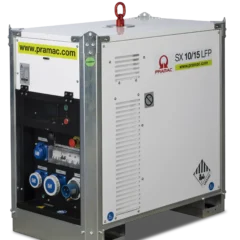
BESS BSO MAX PRO 90/188
Pramac BSO MAX PRO 90/188 – all-in-one 90 kVA / 188 kWh lithium-ion (LFP) battery storage system in an IP54 outdoor cabinet. On-grid and backup (off-grid) operation, components pre-installed, redundant air conditioning and aerosol fire suppression. Australian specification
Commercial & Industrial Storage (behind-the-meter and large-scale)
Industrial energy storage is ideal for facilities looking to reduce energy costs and improve resilience. Modular indoor battery systems can be expanded as needs evolve and are commonly deployed for PV self-consumption and peak shaving. Commissioning and optimisation are typically managed via a web interface that visualises loads and energy flows, with the ability to schedule charge/discharge across the week—plus real-time monitoring and maintenance from anywhere.
For outdoor installations, all-in-one assembled systems and containerised battery storage provide robust deployment options, supported by energy management systems (EMS) that intelligently control energy flow, and battery inverters designed for commercial, behind-the-meter applications like self-consumption optimisation and peak shaving.
Ozwide BESS Simulator
The BESS Hybrid Simulator lets you model a Battery Energy Storage System together with a generator and optional solar PV. You enter your load profile (power demand over time), choose Off-Grid or On-Grid mode, and select generator and BESS models. One click runs the simulation and shows fuel savings, run hours, costs, and CO₂ impact compared with generator-only or grid-only. Use it to compare scenarios and size hybrid or BESS solutions before you buy.
12V vehicle socket (120W max)
Dual 12V DC outputs
USB-A, USB Fast Charge, and USB-C (up to 100W)
Solar input: up to 400W (parallel panels supported)
Vehicle charging: 12V input supported
Emergency Power Supply (EPS ≤10ms transfer)
Built-in protections: overload, thermal, low/high temp
Parallel capability increase capacity
IP20 rated
12V vehicle socket (120W max)
Dual 12V DC outputs
USB-A, USB Fast Charge, and USB-C (up to 100W)
Solar input: up to 800W (parallel panels supported)
Wide DC input: 12–60V range
Emergency Power Supply (EPS ≤10ms transfer)
Built-in protections: overload, thermal, low/high temp
Parallel capability up to 4800W total Output
IP20 rated
-scaled.png)
-scaled.png)
Showing 1–10 of 11 resultsSorted by latest
-
 Read more
BESS BSC Series
Fully pre-installed, containerised lithium-ion energy storage solution designed for large-scale commercial and industrial applications. The BSC Series delivers a turnkey, all-in-one system combining battery capacity, power electronics, thermal management, safety systems, and energy management in a single containerised platform.
-
 Read more
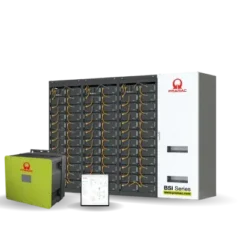
BESS BSI
Fully pre-configured, indoor lithium-ion energy storage solution designed for commercial and industrial applications requiring reliable, scalable, and high-performance battery storage. The BSI combines proven battery technology with integrated power electronics to deliver a turnkey solution with minimal installation and commissioning effort.
-
Read moreMORE INFO
BESS BSO MAX PRO 90/188
Pramac BSO MAX PRO 90/188 – all-in-one 90 kVA / 188 kWh lithium-ion (LFP) battery storage system in an IP54 outdoor cabinet. On-grid and backup (off-grid) operation, components pre-installed, redundant air conditioning and aerosol fire suppression. Australian specification


-240x240_c.webp "1200(1)")
Viewed 10 of —